
Every rural property we visit across Australia and New Zealand, one of the first things we get taken to is the fuel storage. It looks pretty similar no matter where you go. Whether it’s a cattle stud near Cooma with a couple of thousand litres or a station in the Top End with 15,000 litres sitting visible from the highway, the setup is usually familiar.
Then there are the big fuel users — the cropping properties feeding the country. You’ll see the 36,000L tanks that look like submarines, or the newer shipping container-style setups with pin code security, like those from IOR.
Either way, on most properties we visit, the fuel is usually located in the same spot, just outside the workshop or machinery shed. It makes sense, because that’s where the vehicles and machinery are coming and going all day. On bigger operations, you will see the fuel tanks positioned further away so road trains, planters, and harvesters can pull up alongside.
What that also means, particularly on the larger places, is that the tanks end up a bit further away and a bit more out of sight. When they’re right next to the main work area, things get noticed a little better.
For years, fuel storage was straightforward. A tank up on a stand to gravity feed when needed, one for diesel and a smaller one for unleaded to top up the bikes. Nowadays, there’s a lot more variety — larger volumes, more sophisticated setups, and more and more producers storing Avgas on site.
Fuel Theft Is More Common Than You’d Think
For as long as we’ve been doing this, fuel security has been an issue. We’ve heard stories from just about every corner of the country from producers, about either their own place, a family member, or their neighbours, that have lost fuel or at the very least reckon they use it a bit quicker than they should be.
Most of the time they say it’s the classic pig hunters or roo shooters cruising around helping themselves to a tank here and there. Too often, we fine it turns out to be an employee, a contractor, or even a mate taking a sneaky few litres.
What astounds us most is how many properties have absolutely no measuring or tracking technology on their fuel storage. At a guess, based on our travels and discussions with producers on the topic, we’d guess only around 25% of producers make any real attempt to record fuel usage — and probably closer to 10% have any kind of electronic monitoring or security in place.
Tracking Usage
When it comes to protecting fuel supplies the first and easiest step is tracking who is using it. Similar to stock theft, it’s difficult to do anything about it when you are reporting a crime that might have happened months ago. If you are tracking usage, you will have a more accurate report when there is a discrepancy.
We see the old classic fuel meter and logbook being used across operations small and large – and honestly, it does work. There’s just a level of trust required Trust that workers fill it out correctly, put in the right vehicle, or put in anything at all. Just the other day up near Nebo in Queensland, a property owner told us their fuel usage was all under control because they tracked it in a logbook. The manager sitting next to them immediately said, “Yeah, but no one fills it in though.”
A fuel monitor that does the counting for you is a much better option. One that records every litre that flows out, or every time the tank level changes, means you know when fuel is being used, you’re less likely to run dry, and you’re more likely to catch unusual activity early. There are a couple of good ones around, Farmbot in particular have a great option – Fuel Tank – Farmbot. Pair that with a logbook and you’ve got a system that’s a lot harder to fudge.
To Lock or Not to Lock?
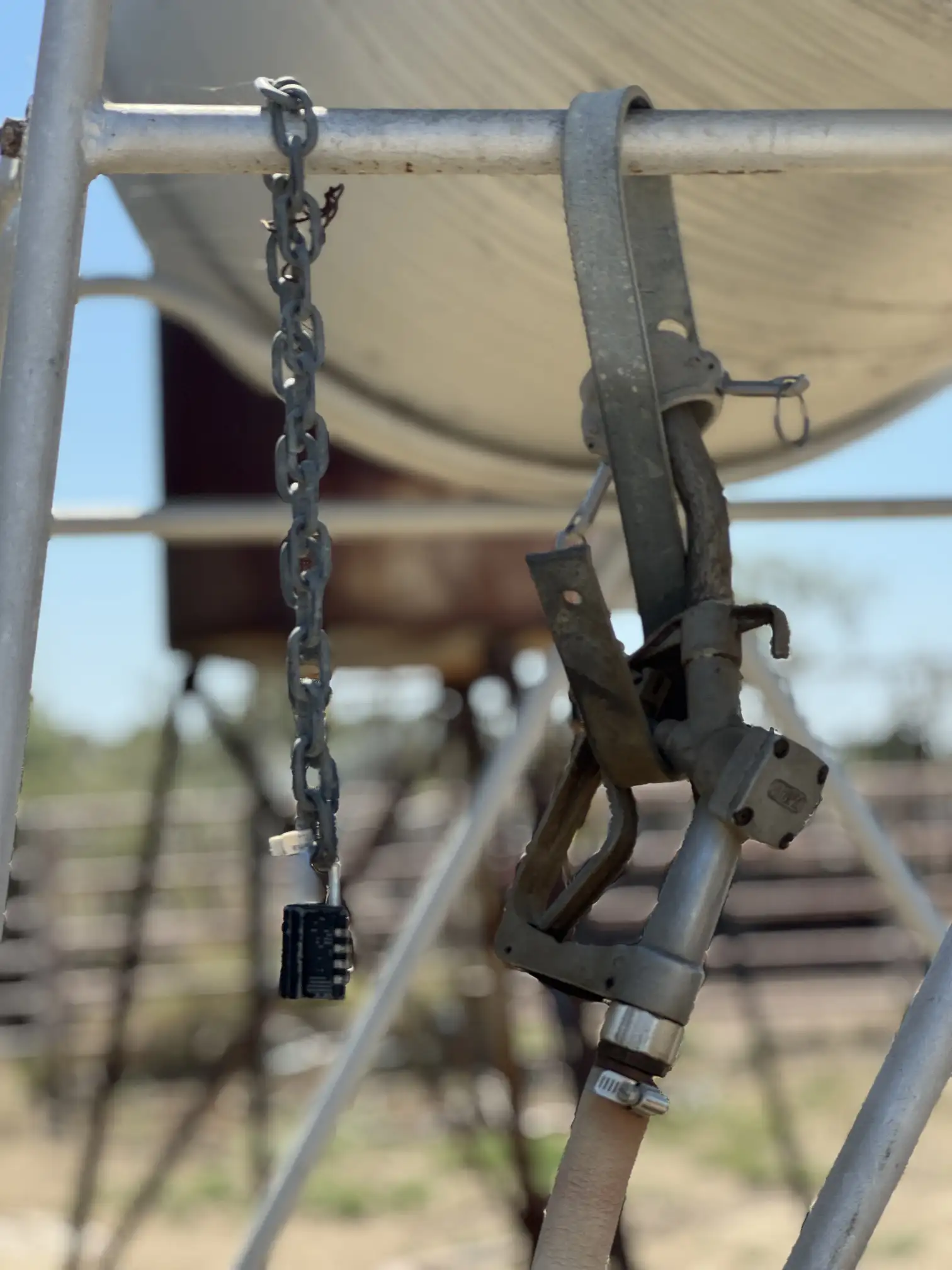
The other angle, apart from tracking usage, is restricting access. We have seen plenty of attempts from a simple padlock on the hose handle, a padlock on the tap or just recently a full steel cage rapping around the hose and pump.
When it comes to locking up the fuel, contrary to popular opinion we usually advise not to – unless you’re going all out like the steel cage option. Unfortunately, what we hear too often is that someone trying to pinch fuel finds the handle locked, so they cut the hose instead. They fill up and drive off — and the rest of the tank drains out. Recently, a farmer in Victoria experienced just that. Often, what would have been a 60L loss becomes 2,000L. We don’t want to make it easy for crooks, agreed. But we also can’t afford to forget how irrational a determined thief can be.
The same thinking applies to machinery. Locking fuel caps will stop a lot of the opportunistic types. But occasionally you hear of a hose cut or a tank damaged to get around the lock — and that repair costs far more than the fuel ever would have.
What We Actually Recommend
So, here’s what we want to see, based on all the time we spend helping producers protect their fuel.
Number one — get eyes on the tank (no surprise here)
More specifically, on the hose itself. You see, there’s no point putting money into a camera system only to end up with footage of a white Hilux parked near the tanks. If someone has done the deed and flogged a good portion of fuel that you have put your hard-earned money into buying, you want clear footage of them picking up the hose and filling up — whether that’s a trespasser, a worker, a family member, or a neighbour. Every use of that tank accounted for.
Number two — track your usage
This works best when it’s hand in hand with a camera, so you can cross-reference without relying on honesty. One of our clients in Central Queensland found out the hard way — going back through records to investigate above-average fuel usage, sure enough there’s a worker on camera filling up a private vehicle. In the logbook, he’d written down the correct amount, but had the vehicle down as the work truck.
Number three — think about where your tank actually is.
This one can feel like a bit of mucking around, but it’s often the cheapest and most effective change you can make. So often tanks have been sitting in the same spot for 20 years for no reason other than that’s where they were put.
A couple of things worth checking: can your fuel tanks be seen from the road, and is there a way to reach them without going near the house or sheds?
We worked with a producer in southern Western Australia who was struggling with fuel theft. We advised on camera placement and positioning — but before anything else, we asked whether the tanks could be moved. They were sitting on the outer edge of the property on a separate driveway that came off the road, making them easy to spot and approach without being noticed. He said they’d just been put there when the tanks arrived. Moving them behind the sheds — out of sight and a little harder to access — didn’t affect how the farm ran, but it made them a far less obvious target.
It’s About Protecting Your Livelihood
With fuel prices all over the place at the moment and media hype out of control it really is a growing priority to protect your on-farm fuel assets. One grower from the Darling Downs in QLD explained to me that for him, the increase in price wasn’t the biggest concern — at that point diesel was sitting at $2.45 a litre. What he was thinking about was his 60,000L supply. If something happened to it and replacement was delayed, planting wouldn’t happen on time. That kind of disruption costs a lot more than the fuel ever did.
If you heard of a service station in town being robbed, and the crooks got away without a trace because there were no cameras – you would consider them reckless and negligent. And yet time and time again we see properties that carry nearly comparable value in combined assets of stock, fuel, machinery and inputs that have no form of protection at all.
The craziness of the fuel prices will come and go, but maybe this is the time where you decide to protect not just your assets but your livelihood.